Archives: News
-

2nd Networking Workshop – Collab4Resilience
We invite all our members to join the second Collab4Resilience Networking Workshop, bringing together our community dedicated to strengthening scientific cooperation and sustainable innovation. The workshop will take place online on 25 November, 12:00-13:30 CET. If you are not yet part of the network but would like to get involved, you’re welcome to reach out.…
-

The CheMatSustain Database: Digital Driver of Sustainable Materials Research
The CheMatSustain (CMS) Database is a central platform for collecting, organizing, and exploiting research data generated within the project. Experimental results from the Work Packages (WPs) are curated, stored, and made accessible as structured, usable datasets. Purpose of the Database The CMS Database enables the systematic storage and visualization of experimental outcomes. It supports further…
-
European Researchers’ Night: Connecting Science and Society
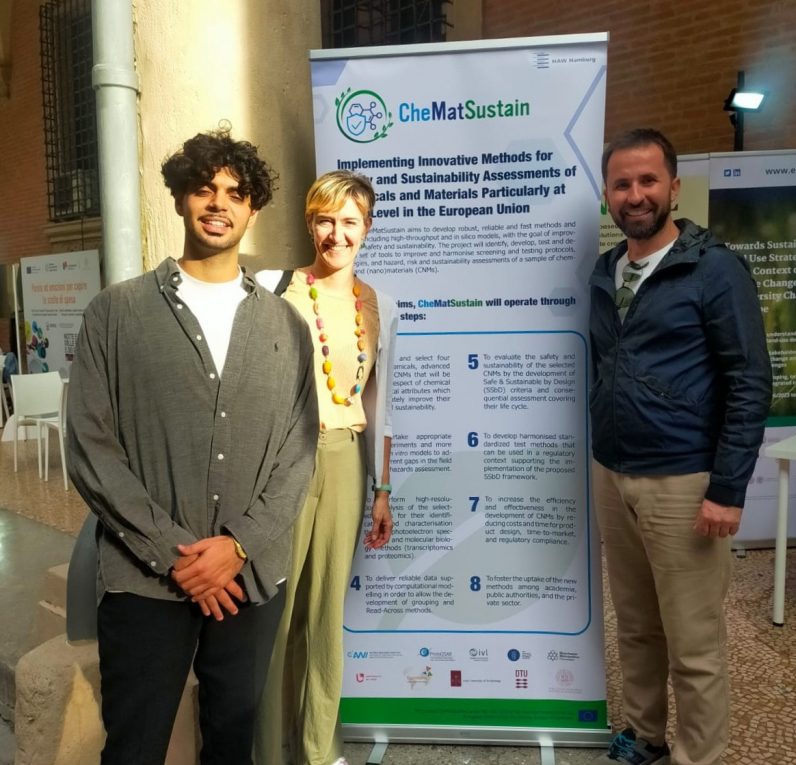
Every September, across the European Union, laboratories and lecture halls open their doors to the public for the European Researchers’ Night. For nearly two decades, this flagship EU event has brought researchers and citizens together in a spirit of curiosity, dialogue, and exchange. It is more than just an open house: it is an invitation…
-

From Data to Dialogue: Insights on the Stakeholder Engagement at Venice 2025
As part of the ongoing outreach efforts of the CheMatSustain (CMS) project, an in-person workshop was held to gather expert input on crafting a concrete and effective strategy for advancing knowledge exchange of CMS outcomes through the CheMatSustain Facility (CMSF). The event, included in the Venice Training School 2025’s program, was titled “Designing a Knowledge…
-

General Assembly and First Project Review concluded
Last week, the CheMatSustain project team came together in Bologna, Italy, for two major events back-to-back, the third General Assembly as well as the first Review Meeting of the project. The meetings were hosted by the University of Bologna in the historic Palazzo Poggi, part of the prestigious campus. On 25th June, the 3rd General…
-

The CheMatSustain Facility is Live!
We are excited to announce the upcoming official launch of the CheMatSustain Facility! Beginning June 27th, this online platform will be available to support collaboration, knowledge exchange, and innovation in the field of safe and sustainable nanomaterials. As a member of the public, the CheMatSustain Facility will serve as your go-to place for information, updates,…
-

Strengthening Research and Educational Ties: UNIURB and TUL Collaborate on CNM Toxicity Testing
A dynamic collaboration between the University of Urbino Carlo Bo (UNIURB, Italy) and Lodz University of Technology (TUL, Poland) continues to grow under the framework of the CheMatSustain project, specifically within Work Package 3 (WP3), which focuses on pilot testing metabolic responses to selected chemicals and nanomaterials (CNMs). As part of these joint efforts, Dr.…
-

CheMatSustain’s First Interactive Review Workshop: Co-Creating the CheMatSustain Facility
The CheMatSustain consortium recently held its first interactive review workshop, marking a significant milestone in the co-development of the CheMatSustain Facility, an emerging decision-support platform designed to centralize and streamline data on nanomaterials for use by researchers, policymakers, and industry stakeholders. This event represented a key step in stakeholder engagement, offering a space for meaningful…
-

Understanding the Role of Life Cycle Assessment in Nanomaterial Research
Nanomaterials are so small they are invisible to the naked eye, yet powerful enough to revolutionize any industry, but with their great potential come great risks. How do we ensure these materials, often hailed as a new step in the industrial revolution, are safe for both people and the planet? One tool used for this…
-

Kick-off of Collab4Resilience Initiative: Uniting EU Projects for Stronger Scientific Communication
On April 8th, 2025, the Hamburg University of Applied Sciences (HAW Hamburg), in its role as coordinator of the CheMatSustain project, successfully hosted the kick-off workshop for the new initiative Collab4Resilience – Stronger Together in Science and Sustainability. The initiative aims to strengthen collaboration among EU-funded projects working on Safe and Sustainable by Design (SSbD)…